Deconstructing Sound: On‑Device AI Vocal Removal
From phase cancellation and traditional DSP to deep learning and embedded deployment, this article explains how on-device AI performs real-time, low-latency source separation in audio hardware.

Removing the vocals from a finished mix while keeping the complete instrumental track is a longstanding goal. It is like kneading several colors of modeling clay into one muddled ball: separating them back into their original forms is nearly impossible in the physical world because mixing is inherently an “irreversible” process of combining information. In digital audio, however, algorithms aim to perform exactly this kind of reverse separation, disentangling intertwined waveforms into independent tracks once again.
Phase Cancellation: A “Soundstage Coincidence” That Never Quite Works
The earliest technique to see widespread use was phase cancellation. Its principle is straightforward: in most popular music, the lead vocal is placed at the center of the stereo field, so the vocal signal is essentially identical in the left and right channels. If the waveform in one channel is inverted by 180 degrees and then combined with the other channel, signals at the same pan position cancel one another, leaving behind instruments positioned toward the sides.
This technique emerged as early as the 1960s and remains common in the “vocal cancel” buttons found in media players and karaoke equipment. Its advantages are zero latency, negligible compute demand, and no need for additional audio algorithms.
Its limitations, however, are obvious—and structural.
Phase cancellation operates on pan position rather than the semantic concept of a “vocal.” If the mixing engineer also places the kick drum and bass in the center, as is standard practice in modern recordings, they disappear along with the voice. If stereo reverb has been applied to the lead or the vocal has been double-tracked, the parts that fail to cancel turn into strange phase artifacts. The technique is entirely useless for mono recordings: because the left and right channels are identical, subtracting one from the other leaves only silence.
The Rule-Based Limits of Traditional DSP
To overcome the drawbacks of phase cancellation, audio engineers introduced more sophisticated signal-processing techniques. These included adaptive filtering based on spectral differences between voices and instruments, decomposing and regrouping a spectrum through non-negative matrix factorization (NMF), and analyzing repeated passages in an accompaniment to infer and subtract the vocal. Compared with simple phase inversion, these methods did improve results in certain scenarios.
Traditional DSP still faces a fundamental barrier: every selection criterion depends on rules written by engineers. Real-world music is enormously complex, with languages, singing techniques, arrangement styles, and mixing practices all interacting. No fixed set of rules can cover them all. An engineer may add a rule to improve one genre only to degrade the sound of another.
This inescapable trade-off did not fundamentally change until deep learning entered the audio field.
Deep Learning: “Help Me Unmix This Ball of Clay”
Around 2014, techniques that had made convolutional neural networks successful in image recognition began moving into audio processing. Researchers changed their approach: rather than writing rules by hand, they fed models vast paired datasets of mixes and isolated tracks, allowing neural networks to learn separation patterns for themselves.
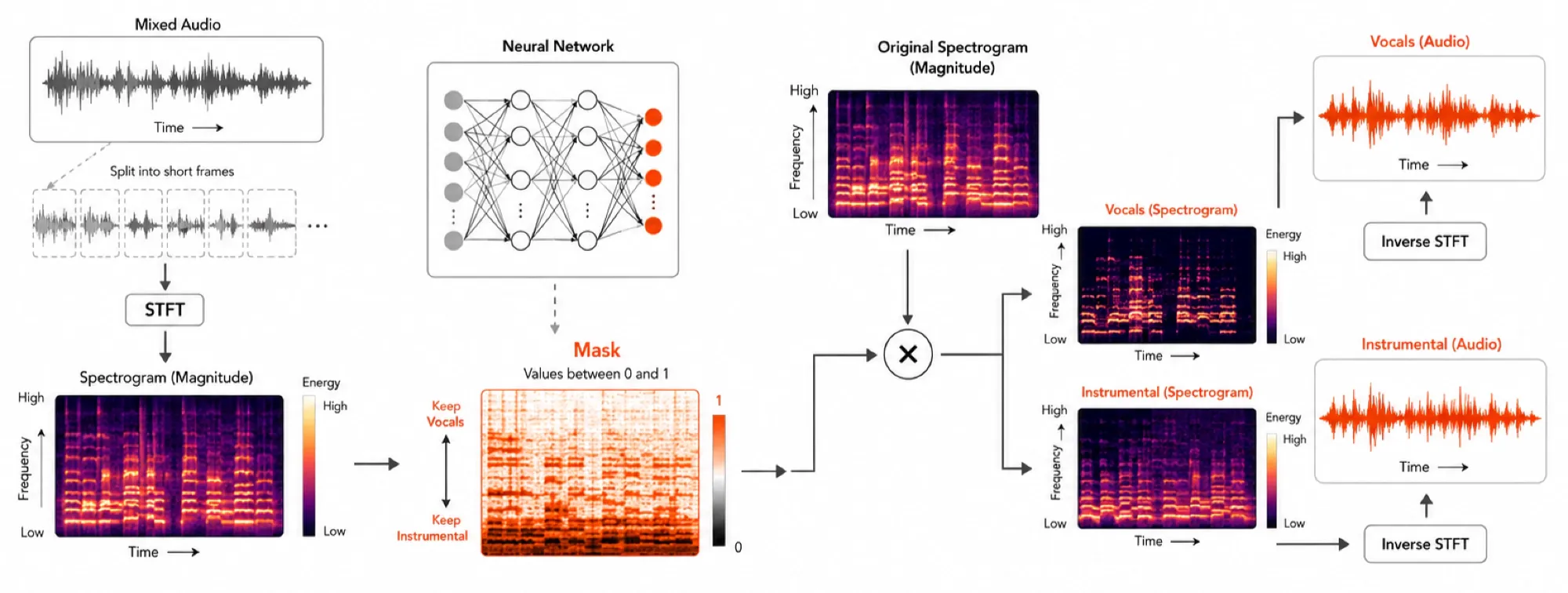
How neural-network vocal removal separates vocals and instrumental audio from a mixed song.
In a typical implementation, the audio is first divided into short frames and converted into a spectrogram through a short-time Fourier transform (STFT). Time runs along the horizontal axis, frequency along the vertical axis, and color intensity represents energy. The neural network takes this spectrogram as input and predicts a “mask” of the same dimensions, specifying how much vocal and accompaniment to retain at every time-frequency point. Multiplying the original spectrum by the mask extracts the vocal component, which is then converted back into a time-domain waveform through an inverse transform.
This process relies heavily on high-quality paired data: audio material that includes both the complete mix and separate vocal and accompaniment stems. The widely used MUSDB18 benchmark dataset, for example, contains 150 complete songs with isolated tracks for vocals, drums, bass, and other instruments. By comparing its output with the reference tracks, the model repeatedly adjusts its parameters through backpropagation until it reaches the desired separation accuracy.
In 2019, Deezer open-sourced Spleeter, a U-Net-based system that could separate a song on an ordinary computer in seconds and deliver a substantial perceptual improvement over traditional algorithms. Sony’s Open-Unmix used a bidirectional LSTM to model spectra, giving researchers a clear comparison baseline. Later that year, Demucs from Meta (formerly Facebook AI Research) went a step further: it skipped spectral conversion and separated sources end to end in the raw waveform, using an encoder-decoder architecture and temporal convolutions to reconstruct masked detail.
These first-generation AI models shared one assumption, however: they were designed for servers or GPU-equipped desktop systems with abundant compute. They could not meet the requirements of integration into embedded audio devices.
Three Essentials for On-Device Deployment: Algorithms, Compute, and Use Cases
Moving AI vocal removal from the cloud or desktop into a hardware device is not simply a matter of trimming a model. It requires a balance among the algorithm, the hardware, and the application.
Early models such as Demucs contained tens or even hundreds of millions of parameters and demanded enormous amounts of computation. Running them on an embedded chip without a discrete GPU or large memory pool generally requires systematic model compression. Quantization converts 32-bit floating-point values to 8-bit fixed-point values; network pruning removes redundant connections; and knowledge distillation uses a larger model to guide the training of a smaller one. Together, these methods can reduce a model from hundreds of megabytes to just a few while preserving the perceptual quality of separation as far as possible.
Once the algorithm is smaller, the hardware must still provide enough processing power. Traditional general-purpose MCUs struggle with the dense multiply-accumulate operations required for AI inference. As heterogeneous SoCs designed for audio processing have become more common, chips have begun to integrate MCUs, low-power DSPs, and AI acceleration units. Audio DSPs such as the Cadence HiFi family continue to improve vector computation and power management, making it possible to run neural networks at milliwatt-level power. The Actions ATS362X series, for example, incorporates a HiFi5 DSP, supports 32-bit audio-processing precision and multiple digital audio I/O channels at a 48 kHz sampling rate, and can run lightweight AI networks efficiently.
At the same time, applications are making the need for offline, low-latency processing increasingly clear. In karaoke speakers, local vocal removal can operate independently of a particular song-request app or accompaniment track. In live-streaming audio interfaces and stage monitoring systems, local processing avoids the uncertain latency of cloud transmission. For instrumental practice, it also makes it easier to extract or suppress a particular part at any time.
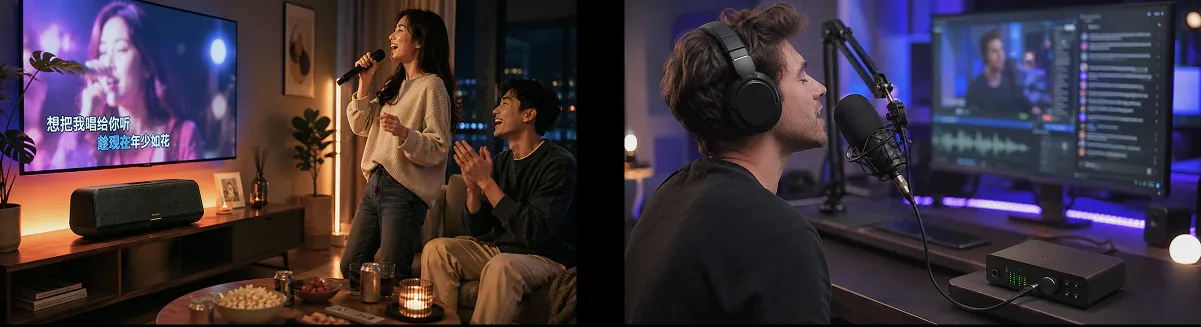
Real-time on-device AI vocal removal running in karaoke speakers and live-streaming audio interfaces.
As model compression, heterogeneous chips, and application demand converge, real-time on-device AI vocal removal is gradually becoming commercially viable.
From Borrowing Host Compute to Shipping Compute with the Device
Offline software, real-time host processing, and processing embedded in the device each occupy a different position among the available approaches to AI vocal removal.
Offline software typically processes imported files asynchronously, prioritizing model scale and perceptual separation quality for post-production work. Desktop DAW plug-ins and mobile apps can process audio streams in real time, but they consume CPU, GPU, or NPU resources on a connected phone or PC and depend on operating-system scheduling and driver routing. An embedded solution instead deploys the model on a DSP or dedicated compute chip inside the device and performs inference directly in the audio signal path.
The real advantage of embedding the algorithm in the device is that the AI inference capacity required for vocal removal ships with the hardware. Because compute-intensive separation remains inside the device, the connected host no longer needs to run the AI inference model. It can devote more of its resources to streaming, video encoding, effects processing, and multitrack recording, reducing the risk of audio glitches or dropped frames under heavy system load.
For standalone audio hardware such as karaoke speakers, live-streaming audio interfaces, and stage monitoring systems, shipping the compute with the hardware means fewer external dependencies. The separation experience is no longer limited by the performance of a connected phone or computer, nor does it force users to install a particular driver, plug-in, or host application. Even when an external device serves only as the playback source, vocal removal can continue running reliably inside the hardware.
This on-device approach simplifies the end-user workflow while leaving model compression, power scheduling, and embedded porting to the hardware manufacturer. For audio hardware designed around instant-on operation and a consistent experience, integrating both the processing function and its inference capacity offers a more dependable way to deliver the feature.
Pawpaw Technology’s On-Device Solution
Bringing AI vocal removal to consumer hardware requires advances in model pruning, DSP performance optimization, and audio signal-chain integration at the same time.
Pawpaw Technology has deployed a lightweight AI vocal-removal network on a dedicated audio DSP platform, enabling local, real-time processing of music at a 48 kHz sampling rate, with multiple analog and digital audio I/O channels and real-time parameter adjustment. The solution is already used in several customer products in mass production. It has also attracted broad attention at major industry exhibitions and received the 2026 GAS Outstanding Technology Innovation Case Award.
For manufacturers of audio interfaces, consumer audio products, and professional audio equipment, Pawpaw Technology provides a complete technical solution spanning the on-device AI vocal-removal algorithm and hardware integration, helping partners rapidly strengthen their products’ audio-processing capabilities.
Subscribe to Our Newsletter
Be the first to know about our latest news and product releases.
No spam. Unsubscribe at any time.
Read More
View All →
Best Practices for Audio Capture in Large Conference Rooms (2025)
July 31, 2025
DSP Hardware vs. Software in Remote Meetings: Who Ensures Sound Quality?
July 15, 2025
From Lightning to USB-C, Have Power Supply Issues for Portable Audio Interfaces Been Solved?
July 11, 2025
Stanford University Releases the AI Index Report 2025: Key Takeaways for Businesses
June 30, 2025
What is Digitally Variable Directional Microphone?
June 20, 2025
How to Choose an Audio Interface for Live Streaming: A Guide for Game, E-commerce, and Talent Streaming
June 13, 2025News
Stay updated with the latest news, product releases, and industry insights from Pawpaw Technology.
View AllLet's Work Together!
Creating products with outstanding sound
Let's Work Together!
Room 507, Block B, Phase I Tianan Innovation and Technology Plaza Futian District, Shenzhen, China
New Business
sales@pawpaw.cnTechnical Support
support@pawpaw.cn